Anthony Burgess (1917-1993) – also called Joseph Kell, original name Jon Anthony Burgess Wilson
English novelist, composer, and critic, whose novels are characterized by verbal inventiveness and social satire. Burgess also wrote several biographies. However, the author’s first love was music: he composed a number of works before publishing his first books. Among Burgess’s most famous novels is A Clockwork Orange (1962), which has achieved a cult status after it was filmed by Stanley Kubrick.
John Anthony Burgess Wilson was born in Manchester into a Catholic middle-class family. His father, Joseph Wilson, was a cashier and pub pianist. After his mother Elizabeth Burgess Wilson died in the flu pandemic of 1919, he was brought up by a maternal aunt and later by a stepmother. At school he found it hard to make friends. “I was one despised, ” Burgess once recalled. “Ragged boys in gangs would pounce on the well-dressed, like myself, and grab ostentatious fountain pens.” Burgess studied at Xaverian College and Manchester University, where he read English language and literature, graduating in 1940. During World War II Burgess served in the Royal Army Medical corps, leaving the army as a sergeant-major. In 1942 he married Llwela Isherwood Jones, who died of alcoholic cirrhosis in 1968.
From 1946 to 1950 Burgess lectured at Birmingham University, he was the Ministry of Education lecturer in phonetics, and taught at Banbury Grammar School. In 1954 Burgess became an education officer in Malaya and Brunei, and wrote during this time his trilogy Time for a Tiger (1956), The Enemy in the Blanket (1958), and Beds in the East (1959). Later he said that “Malaya acted as a midwife to a wordly gift that had an inordinately long gestation.” The work juxtaposed the progressive disintegration of a hapless British civil servant, Victor Crabbe, against the birth of Malayan independence. At the time of its appearance, the trilogy attracted relatively little attention.
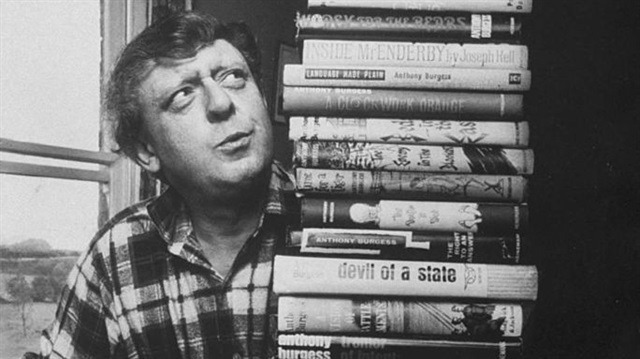
After collapsing in classroom at the Sultan Omar Ali Saifuddin College in Bandar Seri Begawan, Brunei, Burgess returned to England. “One day in the classroom I decided that I’d had enough… I just lay down on the floor.” Later Burgess told, that he was diagnosed as having a cerebral tumor, and given twelve months to live. It has been suggested, that the story was fabricated – there’s no medical evidence for his too early death sentence. However, Burgess set off a rush of literary activity and lived another 33 years. He wrote feverishly, producing over fifty books and hundreds of journalistic pieces. His first wife Lynne proposed the pseudonym Anthony Powell and her second suggestion was Anthony Gilwern. Burgess was the maiden name of John Wilson’s mother. He also used the pseudonym Joseph Kell and once reviewed Kell’s novel Inside Mr Enderby (1963) for the Yorkshire Post; when the editor sent him the author’s novel – Burgess thought it was a practical joke but it wasn’t. Burgess himself wrote letters to the editor of the Daily Mail as Mohamed Ali, an outraged Pakistani moralist.
In 1959 Burgess devoted himself entirely to writing, living since in Malta, Italy, US, and Monaco. Upon learning that the Catholic Church in Malta had banned Desmond Morris’s book The Naked Ape, he delivered a lecture at Malta’s Royal University, demanding that the book should be removed from the Banned List. As as result, the Maltese authorities confiscated his car, a much-loved Morgan, and his house, which then stood empty. Desmond Morris, who lived in a village next to his, defended on a TV debate Stanley Kubrick’s film adaptation of his novel, A Clockwork Orange (1962). The character in the film who appeared as “the writer” was the author himself.
Between the years 1960 and 1964 Burgess wrote eleven novels. The Wanting Seed (1962) depicted an overpopulated England of the future, caught up in the alternating cycles of libertarianism and totalitarianism. A Clockwork Orange, a science fiction fable, made him famous as a satirical novelist. This work was born from the growth of teenage gangs and the universal application of B.F. Skinner’s behavior theories in prisons, asylums, and psychiatric clinics. In 1961 Burgess had also observed the stilyaqi, gangs of young thugs, in Leningrad.
A Clockwork Orange is set in a future London and is told in nadsat, a mixture of Russian, English and American slang, gypsy talk and, odd bits of Jacobean prose. Burgess has given at least three explanations for the title of the book. One is that it is a Cockney expression (“as queer as a clockwork orange”), which he overheard in a London pub in 1945. In an essay published in the Listener, Burgess claimed that the title was a pun on the Malay word orang, meaning man. And the third explanation is that the title is a metaphor for “an organic entity, full of juice and sweetness and agreeable odour, being turned into an automaton.”
Alex, the main character, is a juvenile delinquent, who rapes and kills people with his “droogs” (friends). The scene, in which the gang rapes the writer’s wife, was based on a true event according to Burgess– his first wife was attacked by a gang of American army deserters during WW II. (Roger Lewis, his biographer, found no evidence for the rape.) Eventually Alex is captured, and brainwashed by the Ludovico technique to change his murderous aggressions. As an unexpected side effect of the Pavlovian treatment he starts to hate Beethoven’s music, his unspoiled self.
 Are we clockwork oranges?
Yorum bırakın